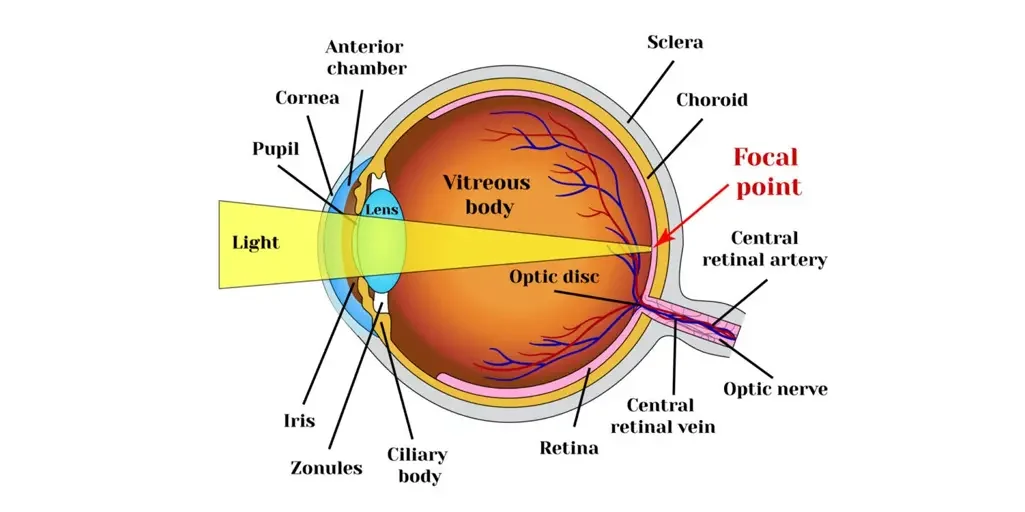
Refractive errors are common vision problems that occur when the eye cannot focus light properly onto the retina, the light-sensitive layer at the back of the eye. This improper focus causes blurred or distorted vision, making it difficult to see clearly at various distances. Refractive errors often result from variations in the shape of the eyeball, cornea, or lens, which affect how light bends inside the eye. More than 150 million people are affected by refractive errors, yet many remain unaware that clearer vision is possible with proper diagnosis and treatment.
There are four primary types:
Cataract Myopia (Nearsightedness): Difficulty seeing distant objects clearly as light focuses in front of the retina.
Hyperopia (Farsightedness): Difficulty seeing close objects clearly because light focuses behind the retina.
Astigmatism: Blurred or distorted vision at all distances due to an irregularly shaped cornea or lens.
Typical symptoms include:
Refractive errors can be caused by:
Abnormal length of the eyeball (too long or short)
Irregular shape or curvature of the cornea
Aging of the lens inside the eye
Genetic predisposition
Environmental factors such as prolonged screen time and eye strain from near work

There are four primary types:
Typical symptoms include:
Refractive errors can be caused by:
Dr. Debaisish Mohanty offers comprehensive treatment options tailored to each patient’s needs, including:
Eyeglasses: The simplest and safest correction method. Specific lenses adjust the focus of light to compensate for the eye’s shape irregularities.
Contact Lenses: These are worn directly on the eye and offer a more natural field of vision. Specialized lenses, such as toric lenses, are available for astigmatism.
Refractive Surgery: Procedures like LASIK reshape the cornea to correct focusing errors, offering long-term vision correction for eligible patients. Other surgical options may involve lens replacement or newer techniques tailored to specific refractive errors.
Lifestyle Adjustments: Regular eye exams, proper lighting, and managing screen time help reduce eye strain and detect changes early.
The four main types are myopia (nearsightedness), hyperopia (farsightedness), astigmatism, and presbyopia.
Eyeglasses use lenses that adjust the path of light entering the eye so that it focuses properly on the retina, improving vision clarity.
Refractive surgery aims for permanent correction, but some patients may require additional treatments or glasses for precision work over time.
Yes, myopia and other refractive errors often develop in childhood or adolescence. Early detection through regular eye exams is crucial.
Genetics play a significant role, as these conditions often run in families, though environmental factors also contribute.
Expert Ophthalmologist & Eye Surgeon. Specializing in Advanced Cataract and Comprehensive Vision Care. Book Your Consultation Today.
Designed With 🤍 by Walk Digitally